Support this site with every purchase with this link.

RPGNow.com

Monday, May 23, 2011

Warrior, Rogue, & Mage. Weapon Qualities.

While looking around on stargazer games I noticed that Michael Wolf the author of WR&M was working on a scifi game using the same system, called Wyrm SF (Wyrm being the name of the system these games share). I got intrigued, so went over to the forums to check on progress on it. A post there really caught my interest.

Mr. Wolf proposed the idea of adding tags or qualities to weapons to add uniqueness to them. Here is the post:


 So, let's look at an example:
In RAG a light machine gun has the following stats: Skill (Ranged), Damage (9), Range (Long)
These stats could form the basis for any light machine gun in Wyrm SF. But there might be variants like these:

Gaian Arms Pacifier Light Machine Gun, Skill (Ranged), Damage (9), Range (Long), Tags (accurate, unfoldable bipod)

MarsCorp LMG-17 Light Machine Gun, Skill (Ranged), Damage (9), Range (Long), Tags (high-powered, extended clip)

I thought adding tags to weapons is a way to add a lot of variety to the simple system of WR&M.
For example an assassins dagger could have an armor penetration (AP 1 ignoring 1 point defense from armor) tag. Distinguishing it from other daggers.
I think Qualities is going to be the choice term. 

I have decided that not all items will have qualities. Just items that are well crafted or magical. This will keep the game running simple. But draw greater distinction to better gear and magical items. Items with qualities will fall into 3 categories. High crafted, Master crafted, and Magical.

High crafted: (HC) This weapon is well made by an experienced craftsman. It will cost and often sell for double that of an average weapon of the same type (more if it has another quality attached). High crafted items gain a +1 to damage and can often have one (and only one) other quality attacked to it.

Master crafted: (MC) These items are forged by great masters. Their quality and workmanship have no equal. Master craft items will cost 8 to 10 times that of an average weapon of the same type (depending on the number of other qualities).  High crafted Items gain a +1 to damage like high crafted. But master crafted items may have up to two other qualities attacked to it.

Magic: (MA) This quality shows that a weapon is magical. For all purposes the weapon is a magical item and can strike creatures that could not normally be harmed by mundane weapons. Most magical weapons give off some kind of glow but not all. Most magical items will be imbued with at least one other magical quality. There is no limit to the number of qualities a Magical Item may have on it.

 Added qualities: 


Armor penetrating: (AP) This quality will have a value from 1 to 2 if it is high or master crafted weapon. And can have a range from 1 to 4 as a magical quality. The number represents the number of defense from armor an attack with this weapon may ignore. But only defense from armor.

Accurate: (AC) This quality will have a value from 1 for being a master crafted item. And can have a value from 1 to 3 as a magical quality. This quality gives the user a bonus in combat to strike his opponent.

Slaying: (SL) This quality grants a bonus to damage against a single creature type. This quality will range from 1 to 3 and can only be applied to weapons with the magic quality. Slaying weapons glow brightly when they are with in 100' of the creature they are a slayer of.

Wizards: (WZ) This quality can only be on a staff or Rod. Only weapons with the magic quality may have wizards quality on it. This weapon works as a channel for raw mana. The character may channel one point
of mana into to fire a mana shard at an opponent. The range of a mana shard is 40' and requires a roll on thaumaturgy to hit.
Still underconstruction 

Sunday, May 22, 2011

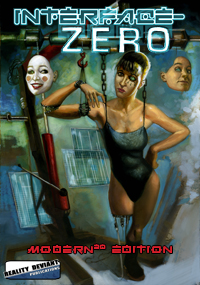
Interface Zero M20

As I'm sure any one keeping track will notice I'm really digging Modern20. While I already had the true20 book for this setting I went and picked it up for Modern20 too. It brought back to me every thing I really liked about it. I've always liked cyberpunk as a setting. A lot of cyberpunk games are stuck in the era they were created in and not really up to date with modern technology let alone future tech. Interface zero is an up to date cyberpunk setting.

What really stands out to me about IZ is the choices in character creation. As with a lot of cyberpunk games you can choose to be a human, genetically enhanced human, and a human altered by animal DNA.  But how many games can you play an AI living in a cyber form body? Or a combat simulacrum? And not just one of each but 3 kinds of AI characters and 3 kinds of simulacrum.

While reading this I got the idea of the hacker of the group who lives in the deep (net) but dons a cyber form body to walk among the meat world. He could also be the wheel man. Actually he could interface with the vehicle and be the wheels.

So many Ideas swirl around in my head about character creation. And its just the first 31 pages of the book. The Timeline and setting info is great. Its a true look forward from the world we live in now and not how the future may have looked looking forward from the 80s.

There is a True20, Modern20, and Savage Worlds version of the setting. I Cant recommend this setting enough to cyberpunk fans.

Modern20 Vampires

As a big fan of the Dresden Files book series I have really been thinking about running a game in it. Or in a modern fantasy setting very influenced by it.

Vampires Play a big part of the Dresdenverse, And I don't think that should be different in my setting. I really like the different types of vampires in the Dresdenverse. Vampires come in three larger species and a number of smaller ones. I really like this approach.

First off though I am going to come up with a basic vampire template. I have chosen to make the vampire template an occupation.

Vampire
Vampires are creatures of the night. They are predators among human kind. Some embrace the beast and revel in being a monster seeing vampirism as a blessing. Others hold on to any shred of their old life and do all they can to hold on to their humanity, to them vampirism is a curse.
Professional skills: Influence, Perception, and Stealth.
Improved Feats: Strength training (+2 Str), Agility training (+2 Agi), Awareness (+2), and Dodge focus (+2 Def).

White Court Vampires: White court vampires are not as powerful as other vampires. But they do not have any of the drawbacks others do either. White court vampires feed off of emotions of their victims. Strong emotions of fear, hate or lust being the food of choice. When a white court is provoked he must pass a willpower roll (14) or his appearance will shift. His eyes become a steel gray and all color fades from his face and skin and it becomes almost transparent. Gray and black veins show through his skin.

Black Court Vampires: These vampires are closer to what we know as vampires. Feeding on blood, repelled by holy symbols and destroyed by sunlight. Many believe Bram stoker was influenced by the white court to write his great book to expose and destroy the black court. Black court vampires gain a +2 to starting strength and gain a natural damage reduction of 2. Black court vampires start with disadvantage: weakness sunlight (3), taking 2D6 damage from direct sunlight. disadvantage: weakness holy symbols (1) repelled.

Tuesday, May 17, 2011

Warrior, Rogue, And Mage.

In the past I used to love big heavy games. Gurps, Hero, and any number of big games. But a lot has changed in past years. Between time constraints and real life intruding my attitude has really changed. These days I really love rules lite games.

A little while back I stumbled across this game over on Stargazer's world. A blog that I visit almost if not daily. The game is called Warrior, Rogue, and Mage.
Its simple and light system, But modular enough to add to it as you see fit. One main concept of the game is no classes. Instead the classes Warrior, Rogue and Mage are your main attributes. The more you put into that attribute the better you are at doing things associated to that class. Warrior is your base attribute for combat and feats of strength. Rogue is your base attribute for subterfuge and feats of agility. Mage is your base attribute for Arcana and Feats of Intellect.

The customization you can put into your character using this system is great. If for example you wanted to make a ranger you could put points into Warrior and Rouge. A Cleric could be a mix of Warrior and Mage.
And an arcane assassin would be a mix of Rogue and Mage. This is a huge step ahead of most simple fantasy systems where picking a race and class combo is about as custom as it gets. There is a good number of examples of fantasy races.

Skills and talents round out the character creation process. (not looking at magic yet). Skills are simple you either are skilled or you are not. A skill gives a +2 bonus to rolls covered by that skill. You can only take a skill based on one of the core attributes if the character has at least one point in that attribute. So if you have no points in rogue, you cant take the thievery skill for example. This is elegant and simple.

The next thing about WR&M I really like is task resolution. Its a roll a D6 and add the appropriate attribute and skill bonus if you are skilled. The die can "explode" meaning if you roll a 6 you count and roll the die again and add it to the total. Adding any more rolls of 6 the same way and rolling again. You roll against a target number based on how complex the task is.

The magic system is a mana point system with difficulties to cast based on how high the circle (level) of the spell is. With armor subtracting from spell casting rolls. The spell list is small but surprisingly covers a lot of ground. Also simple and elegant.

Combat is Hit point based with rolls being made against the targets defense attribute. Combat rolls explode if the character has an appropriate skill and damage rolls always explode.

There is still more I could cover but I'll have to leave it at that for now.

This is a GREAT rules light system. Well worth checking out. A 5 out of 5. To me this is the perfect kind of rules light game. Its light enough for a quick 1 shot, maybe on a night the normal group cant get together. With enough meat on its bones to give it re-playability. And its modular enough to custom to taste for your own setting.

Monday, May 16, 2011

Modern20 Alternate advancement (Part 4 if your counting)


While I really like so much about Modern20. And I find every change from the core d20 to be a major upgrade. There is still a few hold overs from the d20 system I really don't like. As I stated before these are not really concerns any d20 player would even notice. Hit point and feat bloat are two things I just don't like. But still I find it excessive for characters to go into the hundreds of hit points and dozens of feats.

I could never really put my finger on a fix until I started running Castles and Crusades. Some one pointed to the idea of limiting advancement, And the concept behind Epic 6 (which I wrote about here). The idea that since most people are level 1 or even level 0 goons, level 6 is very heroic from that point of view. Even most literary heroes are level 6 or less. (More info on Epic6 wiki).

The only change I would make is in the original Epic 6 characters still gain Exp and still gain feats every time they gain enough Exp to gain a level. I would instead say exp and level still advance but all level dependent bonuses as well as feats stop at level 6.  And only skill points are still gained beyond level 6.

I'm not totally convinced level 6 is the right cut off either. It worked fine for C&C but I kind of wonder if Level 10 would not be a better stop point and just end all advancement there. Still a lot to think about.

For the second part of this post I thought I would share with you a statement by Charles Rice, Author of Modern20. As to the reason for making Modern20.

"Modern20 was where I really tried to go far afield. I had been writing and running modern games since 2001 and had seen them all- Spycraft, Call of Cthulhu d20 and so on.


I really decided to take a different path- instead of trying to make "modern archetypes" like Spycraft I took a different approach- your character is class is about HOW you do what you do, not what you do.

Thus you can have Vic Mackey (from the Shield), Pembleton (from Homicide), or Goren (from Law and Order: Criminal Intent).

Mackey is an intimidating thug (Tank), Pembleton walks into the box and gets you to ADMIT what you did (Star) and Goren uses obscure science and psychology to find a killer by getting inside his head (Brainiac).

And yet, they're all detectives.

D20 modern tried to solve this dilemma with a half measure, through the basic class. In d20 Modern parlance Mackey would be a Tough Hero/Detective, Pembleton would be a Charismatic Hero/Detective and Goren would be a Smart Hero/Detective.

However, I didn't think that went far enough, even with the addition of occupations." 
 

Modern20 part 3.


As well as changing around feats and adding some Modern20 adds disadvantages to the d20 system. Which I think is great. After all making a hero is easy. But with out flaws its hard to make a flawed hero. Flawed heroes and anti-heroes are a staple of the modern game.

Another great change is the elimination of critical hits. Instead there is a hit location system that takes into account extra damage for hits to vital areas. As well as a system for called shots.


Another concept I really like is the use of  Action Points
 "Action Points are that certain something that makes a hero a hero. That spark that causes someone to go out of their way to risk their life for their fellow man, whether fighting terrorists, drug smugglers or creatures of the night."
Action Points can perform the following functions:
• Automatically inflict maximum damage on a successful attack.
• Add the result of your Action Dice to a single d20
    roll (attack roll, skill check, saving throw).
• Automatically stabilize at negative HP
• Grant you an extra action (move or standard action) this round.
The number of action dice you receive grows as your character gains in level as shown on the table below. All dice are rolled and added together.

  Level             Action Dice
1-4                      1D4
5-8                       2d4
9-12                     3d4
13-16                   4d4
17-20                   5d4
"Your total number of Action Points is equal to 6 plus one-half your character level. Each time you gain a level your Action Points reset to your new total. Action Points do not carry over from level to level.
Between levels, there are several ways to recover Action Points including: going to aid of a contact or follower; going to aid of an Allegiance; the activation of a character disadvantage."

Ok, now for my concerns with using Modern20 in my own games. Most class abilities are now feats and progression in feats is a lot heavier with one new feat per level, Like with true20. This is actually something I don't like, Although this should be no problem for most all d20 players. Feat, hit point, and number bloat is one of the things that turned me off of the d20 system to begin with.

So my next post will be how I plan to use Modern20 in my next game.

Modern20 part 2.

 (Disclaimer: I'm not sure if this is a review, a fanboy gushing, or what it is. I just hope that it sheds some light on to what exactly Modern20 is)


A while back I did a little post about modern20. You can find it here. The more I look at these rules the more I like what I see. I thought I would take a little time to dive a little deeper into just what makes this game tick. And what is different about it and D20 modern. (Quotes from the Modern20 book will be in gold

Chapter 1 character creation:
Right out of the box this set of rules differ from D20 modern at Chapter 1 character creation. And truthfully this is where the meat and potatoes of the changes are at. And will be the focus of today's post. In Modern20 you choose a class. The classes were fairly broad allowing you to find one that would encompass the character you planned on playing.

In Modern20 your character First chooses his background, Where did he grow up? what kind of lifestyle did he come from? Was it blue collar, white collar, or academic? There are 16 backgrounds to choose from all together. With room to come up with a few yourself if needed. "Backgrounds provide a basic level in skills and a base amount of Wealth."

Your next choice to make is your occupation. There are 33 occupations to choose from. And again there is room to create more if they are needed for your setting. "Occupations can be changed several times over the course of your career and provide Wealth, skill access, feat access, improved feats and perks."

Next you choose a hobby. This is something your character doe in his spare time away from profession and adventuring. "Hobbies provide a basic level in a single skill."

Next is your characters class. Like d20 modern these are very broad classes. Made with a lot of wiggle room to provide a lot of flexibility within each class. These classes are:

Powerhouse
"Powerhouse characters are the enforcers, those who specialize in taking the fight to their enemies. In many organizations, Powerhouse and Tank characters comprise the “front line”, with Powerhouse characters specializing in expanding influence, while Tank characters specialize in protecting and consolidating any gains."
Speedfreak
"Speedfreak characters are combat oriented, but use their high Defense and enhanced mobility to great effect, attacking where their opponents least expect it."

Tank
"The Tank specializes in sucking up damage. He can take hits that would fell even other combat-oriented characters and come back for more."

Brainiac
"Brainiac characters are thinkers. They are able to master more skill types than any other character class. Brainiac characters are not great fighters but they aren’t completely useless in a fight either."


Empath
"Empaths are always in touch with their surroundings, making them excellent healers and outdoorsmen. They also have the best saving throws of any class, because they are centered and calm in the face of dangers of all types."


Star
"Stars live the good life. They may not be a “star” in the sense of a famous performer but wherever the Star works, he is, well, a Star."
These six core classes cover just about every character type. There is of course rules for multiclassing as well making for a lot of wiggle room when it comes to making the character you want to play. This eliminated the need for basic, advanced and prestige classes. On that same note the core of the rules are still d20. I'm sure if you really wanted some form of advanced or prestige classes you could fit them in with a little house ruling.

The skill list has been streamlined. Its neat and trim with several changes. Some skills were rolled into other skills, others were changed, And even a few new ones added. My favorite part about the skill system is perks. "Opposed skill checks are gone, replaced with targeted".

Perks are a lot like abilities and specializations you gain access to for being skilled and experience in the given area. Like the skill engineering. Perks could give you further knowledge of electrical, structural, or mechanical engineering. Another example of perks is in using weapon skills. Yes weapon skills were added too, but not like you might think. Being skilled with firearms will allow you to know your weapon better.  While weapon proficiency and BaB determines how well you shoot. Firearm skill determines your penalty for multiple shots, penalty for tricky shots, weapon repair, and general knowledge. Perks in firearm gives you access to special attacks like double tap, called shot, and effective burst fire.

The combination of skill and perks system also take a great framework for psionics and magic. With psionics your skill determines your ability to control and understand your powers. And perks must be taken for each type of psionic power. With magic its the same but each perk buys you a new spell. And the level of spells you can learn is limited by your skill level.

There is still a lot left that can be covered like allegiances, reputation, how wealth works differently.

But I think that will have to do it for now.

Power 10 for 5E D&D.

As I play more and more fantasy role-playing games, especially D20 variants, I find that some of my favorites are the ones that boil the ent...