Support this site with every purchase with this link.

RPGNow.com

Monday, September 1, 2014

Dungeons and Dragons 5th Edition


Dungeons and Dragons 5th Edition

The new edition of dungeons and dragons is making its way to gaming tables everywhere. As with many, I was skeptical but optimistic that the game I cut my gaming teeth on would once again be played at my table.

I started with the first edition of Advanced Dungeons and Dragons. I was the GM for my group through the second edition (after a while we just mixed and matched books of both 1st and 2nd) and into the very early stages of the 3rd edition of the game, but stopped playing it well before 3.5 hit the market. I gave 4th edition a try, but did not find 4th to be to my taste. It wasn't that I didn't like 4th, It was just more system than I was interesting in running.

I was fairly active in the D&D Next playtest and feedback process.  When the free Basic rules came out I was pleased that so much of what I liked from the playtest made its way into the final product. I downloaded and printed out the basic rules and started up a game. My players found the rules to be really intuitive and fast playing. In the first few games it was apparent that Hit points and Armor class play slightly different roles in this new edition. 

Armor class is now strictly a measure of the protection that armor and high dexterity afford a character. No longer scaling with level or training. Hit Points on the other hand have always been more an abstract pool of health, luck, training and endurance, but mostly health. Now I would say its mostly endurance and training. Healing and Hit Points are much higher in this edition, But so are the monsters Hit point totals. 

I figured with the higher Hit Point totals, easy access of healing, and non-scaling Armor Classes that players would simply walk all over the creatures in the game. Six sessions since basic set of rules came out and at least one player per game has been on the brink of death at some point. It would seem that monsters in this edition hit fairly hard, And because of non-scaling Armor classes they hit fairly constantly.

Skill rolls, Saving throws, and most other rolls in the new edition boil down to an attribute roll. A d20 roll adding ability modifier trying to beat a difficulty. If your proficient you add a scaling proficiency bonus to your roll. If you have the upper hand in a situation you are said to have advantage, if some one or something gets the upper hand on you your disadvantaged. When having advantage you roll two die and take the higher of the two. When disadvantaged you take the lower of the rolls. That is 90% (or better) of the rules right there.

After a few sessions the starter set came out and we got to see more of the basic game. I was even more impressed with the monster stats and how adding to the basic rules didn't complicate the game or make it any more cumbersome. I have the Player's handbook (two copies actually) in hand now, and are about to start our 7th session.

Now that I've had time to look over the Player's handbook I can say I'm sold on this new edition. It hits a sweet spot that is ideal in games I run. The level of character options are many and the system is simple and intuitive. That to me is the perfect combination.

Players have the option of choosing a race, subrace, background, class, and subclass. No two characters ever need to be or look the same. 

Now that I have the Player's handbook I plan to allow my players to make whatever changes they want using all the options in the book. My player who wanted to play a ranger, he built a fighter with Archery as his fighting style. Can now make his character a Ranger instead now.

Another thing I like about the new edition is the players coming up with their own DIY backgrounds, subraces and subclasses. Great to see so many DIYers embracing the game and making it better with their own contributions. 

Our next session will be a players workshop giving players a chance to modify or even remake their characters using all the material on hand. I'm  very exited as the GM to see the choices everyone will make. I love seeing my players get exited about their characters.

All the core books are not even out yet. Looks like the Monster Manuel will not be out till the end of September and DungeonMasters guide will be out in October. Interesting to think my campaign will be 3 months in before the second core book is even out. But we are running with it.

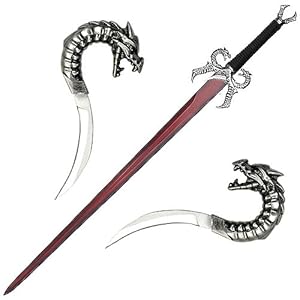
Some blades:

Sword of the Valiant


Five were forged for the knights of Loradin. These were the chosen of Loraun. The first paladins. They accompanied the paladins to the bowls of the black rift, Drew the blood of dark gods and ended the blight upon the land. But were never to return. In game terms these swords are holy avengers. They have no power in the hands of non-paladins. What brave souls would adventure into the depths of such a dark place to retrieve these powerful blades.


The Dragon blood swords of Athenian.
This blade was forged and tempered using the blood of a very old red dragon. It was carried by the legendary high martial Athenian in his campaign to take the highlands from the barbarian horde. It was said he subdued the great drake. Had the blade forged and plunged the still red hot sword into the dragons heart. As the legend goes, after taking the north and subduing the horde. The north was scoured to find an equally old white dragon. A sister sword was forged from the great white dragon. When the Horde returned two years later the swords were lost. Some say the barbarian king has them now. Others believe some survivor of the high martial army escaped with them.  This sword is a fiery sword and its sister sword is a frost weapon. Finding the true resting place of these great blades would be an adventure in and of its self.


Sleshall's Pact blade.
 Sleshall was a Tiefling warlock who through a twist of fate became the defender of a small village from a gange of bandits. Sleshall was killed during the battle but the bandits were all killed or turned away. The blade now sits in the town hall, it is has become a symbol of unity and strength to the people of the village. While this pact blade is not outwardly remarkable it has become a symbol to any one from the area. One day the simple town may become a city. And the blade a symbol of office. Or offered to a party of adventures for defending the village the next time bandits are in the area.

Sunday, July 20, 2014

Nature Domain 5E Cleric (Druid)

This is my attempt to create a "Druid like" Domain for use in my home game for my brother who ONLY plays druids. It was intended to add options to basic before the PH came out. I'm going to keep it around to expand on the basic game. 

Nature Domain
Domain spells:
Level 1 Mage Armor (bark skin), Sanctuary.
Level 3 Spirit Guardians (fey), Lightning bolt.
Level 7 Fire Storm, Regeneration.
Level 9 True Resurrection, Meteor storm.

Bonus proficiency: Nature

Animal companion: Druids start with an animal companion. List to come later.

Channel Divinity: Shape change
Starting at 3nd level, you can use your Channel Divinity
to a druid gains the ability to turn herself into any normal animal CR 1 or less and back again. The effect lasts for 1 hour per druid level, or until she changes back. 

Woodland stride Starting at 3rd level, a druid may move through any sort of undergrowth (such as natural thorns, briars, overgrown areas, and similar terrain) at her normal speed and without taking damage or suffering any other impairment.

 Balance of life
Beginning at 6th level, the druid may bond two friendly targets together. The bond lasts for a number of rounds equal to the Druid's level. Any healing spell cast on either bonded target heals the other for half the number of points. Any damage dealt to either is divided between the two. Druid must have a long rest before another bond can be made.

Elemental Strike
At 8th level, Any spell cast that does fire, lightning, or cold damage does extra 1d8 damage to
the target. When you reach 12th level, the extra damage increases to 2d8. If the spell does more than one type of damage only the fire, lightning, or cold damage does extra damage.

Channel Divinity: Healing Rain
Starting at 18th level, You can call a rain storm 60' radius. The rain continues to fall for a number of turns equal to the druids level. At the start of any friendly targets turn that starts within the rain heals hit points equal to the druids level. Channel Divinity: Healing Rain can only be used out doors and under an open sky.

Martial Archetype: Ranger

Martial Archetype: Ranger
Rangers are specialist Fighters. Rangers are masters of the woodlands and wild places. specializing in ranged and two weapon fighting.

Pre req: Fighting style, Must take Archery or Two weapon fighting.

Level 3: Woodland Stride: Gain skill proficiency in nature and Stealth. Full movement in woodland and wild surroundings. Advantage on Survival rolls in woodlands.

Level 7: Favored Enemy: +2 Damage to favored enemies. Improved crit against favored enemies (19-20). (choose 2) Goblins, Orcs, Gnolls, Kobalds, Fey, Hobgoblins, Undead, Dradonoids, And any other choices allowed by the GM.

Level 9: Combat Master: (replaces Indomitable) Have advantage on hit rolls against favored enemy.

Level 10: Fighting style: gain Archery or Two weapon fighting.

Level 15: Improved Combat Master: Improved crit when using fighting style (19-20), When attacking favored enemy (18-20).

Level 18: Hold the Line: If the ranger chooses not to move and makes a stand he may make an attack on any enemy as a free reaction who comes with in range (melee) or moves into sight (ranged) up to 5 targets. Rangers cant Hold the line again till after a long rest.


Thursday, July 17, 2014

5E Race Dhampir (cursed background)

Dhampir
 
A dhampir is the child of a vampire and a human.While a Dhampir is mortal, the blood of the cursed surges through its veins.

To play the race of Dhampir you must also choose "The Cursed" as your background.

Ability score increase: +1 Str, +2 Dex, +2 Cha.

Age: Dhampir do not age as mortals do. After reaching adulthood their age slows if not halts all together.

Alignment: while free willed dhamire's often tent toward lawful, as they are bound to the laws of the night.

Size:same as human.

Speed: 30'
Language: can speak and read common and one language of choice.

Vulnerability: Radiant and fire damage do maximum damage to Dhamires.
Light sensitivity: extreme discomfort while in direct sunlight.
Children of the night: When using stealth skill at night Dhampires have Advantage.


The Cursed (Background)

Skill proficiencies: Deception, Stealth. 
Languages: Pick two.
Trinkets: Roll 3 times on the Trinkets table. These are precious mementos from the long life that you have lived. Memories of lost loved ones and emotional anchors to the past. It would be painful to lose even one of these items.

Start with 15gp

Personality:(d4)
1    I hate what I am, and try to prove to others that I am no monster.
2    I accept what I am. Curse or blessing.
3    I I have been chosen, I don't think I'm better, I am better than those around me.
4    Its because of those fowl creatures that I am this way, I will destroy them all.

Ideal:(d6)
1   Tradition: The old ways must be upheld. If we don't have our traditions we might as well be animals. (lawful)
2   Redemption: I will do what I can to prove myself worthy of the light. (Good)
3   Freedom: Mortal laws are for mortals, I am beyond them. (Chaotic)
4   Power: I see no reason I should not use what I am to get what I want. (evil)
5   Live and let live: I keep my opinions to myself, I expect others to do the same. (neutral)
6   Knowledge: I will use my gifts and long life to acquire and pass on the experience and knowledge I collect. (any)

 Bond:(d4)
1    I don't make friends easily, But when I do I am loyal to the end.
2    Honor is my life. Bonds and vows are taken to the grave.
3    Protecting those around me is how I prove my worth.
4    I understand that we are not bound by our past mistakes. I will look beyond such things in others.


Flaw:(d4) 
1    I do my best to not let others know what I am. I do everything I can to keep my secrets.
2    Hunters have found out what I am. I gave them the slip and moved on. Its only a matter of time          before the find me again.
3    I don't get close to others, I am different. I cant pretend otherwise.
4    Its hard for me to forgive an insult. Even is I forgive, I don't forget.  


Wednesday, July 16, 2014

Martial Archetype: Paladin (5E)

PALADIN

The Paladin is a fighter who has devoted himself to the will of a god.

Pre-reqs: None, Acolyte background is recommended.

Detect Evil
Paladins can detect evil within 60'. By concentrating for a full action.

Lay on hands
By laying his hands on a friendly target and saying a quick prayer the Paladin can use his second wind to heal that target instead of himself.

Aura of Courage
A paladin can activate an Aura of courage. All allies within 10' of the Paladin gain advantage when rolling to save vs Fear. The Aura lasts till the end of the encounter. Level 1-5 The paladin must have a long rest before using Aura of courage again. Level 6+ The paladin must have a short rest before using Aura of courage again.

Smite Evil
At level 7 a paladin can Smite evil. When making an attack against any target that has been previously been identified as evil using Detect evil the Paladin gains advantage. Smite evil adds a damage bonus equal to the attackers Proficiency bonus. Smite evil can only be used again after a small rest. Level 10+ double proficiency bonus for damage bonus.

Master of Arms
At level 10 the Paladins gains Great weapon fighting or Protection fighting style.

Touch of the Divine
At level 15 the paladin can call on healing from his divine patron. A flash of light centers on the paladin and effects all allies with in 10' of the Paladin. All effected allies roll 1/2 of their current hit die and gains healing equal to the roll. The Paladin must make a long rest before using Touch of the Divine again.

Next:  Martial Archetype: Ranger

Tuesday, June 3, 2014

Alternate magic rules for C&C

I have NEVER been a fan of fire and forget magic of D&D. Even back in the day we used to come up with spell point systems. To each their own and all that jazz, its just not my cup of tea. Ive used a lot of systems over the years but never found one that stuck around for too long and often would resort back to RAW for lack of better options.

In my latest campaign I chose to use Amazing adventures spell casting rules for C&C. And its working out really well. Being the avid tinkerer though I cant resist playing with the system at least a little.

In our games spells are still memorized, but Mana points is spent on casting like in AA. So the average spell cast is a force of will, pure magic shaped to the need of the caster using a formula he has learned. This type of casting requires no components and cost spell level + one in mana points. Memorized spells are treated as a primary trait roll.

Next is ritual casting. Ritual casting is slower, taking at least one full turn. A circle of power or some other magical symbols are scribed on a surface, often the surface being effected. Components are needed (and often consumed) to ritual cast. Circles of power add a bonus based on how elaborate, and components based on how valuable they are. Mana cost to ritual cast is one half rounded down.

Ritual casting can allow a magic user access to spells that are not memorized. Allowing the magic user to cast straight from his spell book. These follow all the rules of ritual casting but are treated as nonprimary for purpose of base difficulty to cast and cost full mana points.

Ritual casting is also being added to my Amazing Adventures games.

Power 10 for 5E D&D.

As I play more and more fantasy role-playing games, especially D20 variants, I find that some of my favorites are the ones that boil the ent...